Diagnosis Story - we all have one
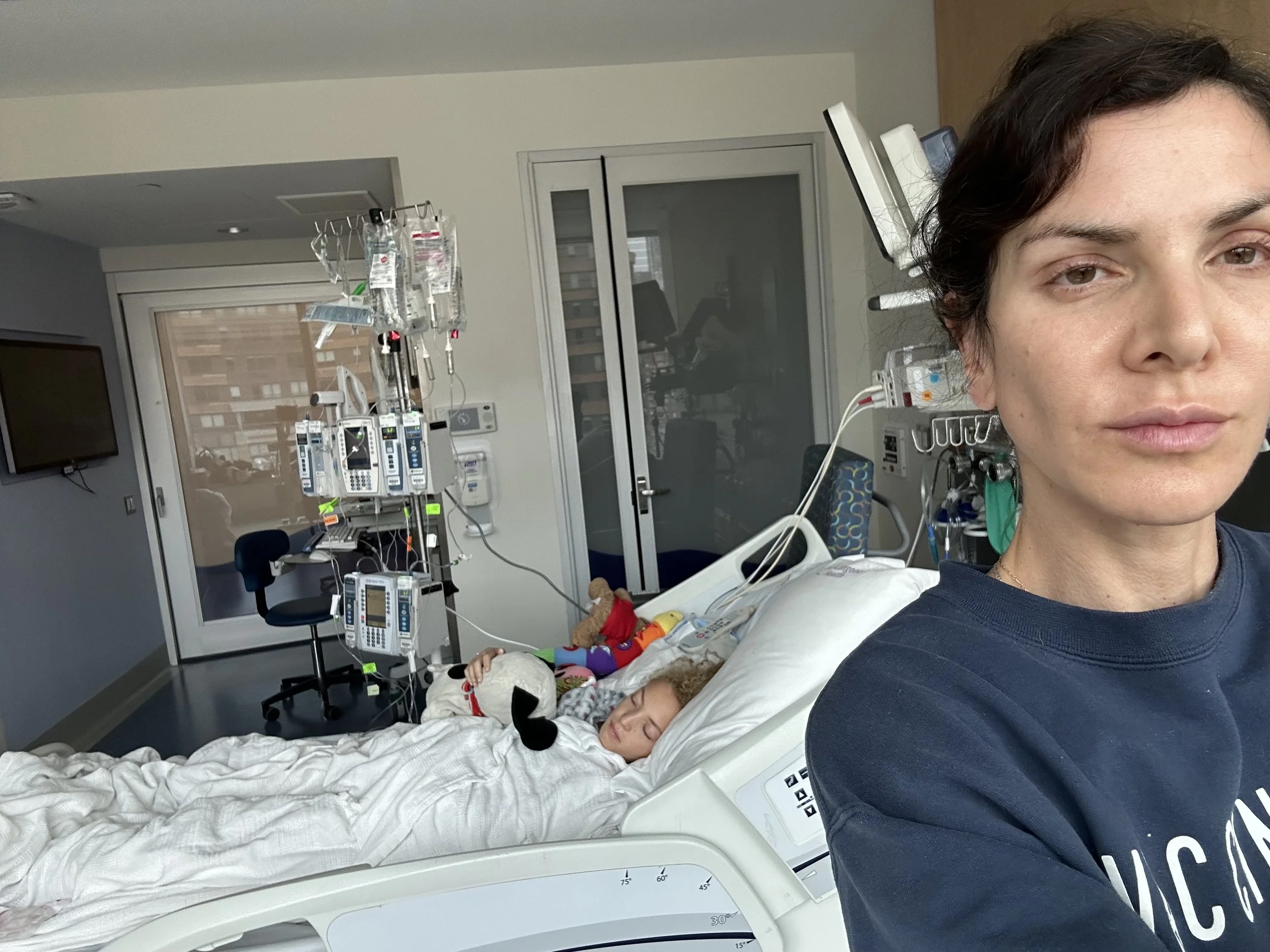
8/30/2024 - our day of infamy
II’m reflecting on our diagnosis date (eight weeks ago today) and how much has changed, what has remained the same, and the resilience of our family. With some new air to breathe and the hardest part behind us, I am blown away by what seems to be endemic in the human experience: the desire to not just survive but to thrive.
I haven’t told our diagnosis story yet largely because it is so painful to revisit that torturous and swampy summer day of August 30, 2024, and the days that ensued. Unfortunately, as we in the T1D world know, many children are diagnosed via an ER visit and DKA. The lucky ones are screened for antibodies or have T1D-experienced parents who can recognize the subtle signs of cumulative high blood sugar.
Jolie (9 years old), was admitted to the ER completely unconscious, visibly emaciated at 55 pounds, and with a cold-to-the-touch 94 degree temperature. Her breathing was heavy and bone chilling. Heavy is not an accurate word to describe the phenomenon of Kussmaul respirations—the body’s attempt to burn off excess acid in the bloodstream (carbon dioxide) via rapid and deep breathing. I never want to hear or see that again, and I’ll never be able to unsee her tiny chest rising and falling as her stressed heart undulated her rib cage. Racing Jolie into the ER felt truly surreal—I call up a crystallized memory of carrying my emaciated and unconscious daughter through the waiting room proclaiming, “My daughter needs to be seen RIGHT NOW!” I know now this was the first of many advocations a parent must do for a child who suffers from a chronic condition. The waiting room was full of tired and stressed patients with broken bones, undiagnosed respiratory viruses, mild burns, and who knows what else. The staff promptly placed Jolie into a wheelchair and ushered us in. A few patients offered us a prayer gesture; several made and sustained eye contact with me, as if to tell my terrified being, “I don’t know you, but I care.” The shared human experience in that Brooklyn Heights ER was palpable.
Jolie was immediately diagnosed when her finger prick revealed a shocking blood glucose level of 1174 (which I have since had tattooed on my upper thigh in an insulin injection site, a feeble gesture of empathy). Since I knew absolutely nothing about diabetes and blood sugar, that number didn’t register to me. In the coming days and weeks I would learn that her case of DKA was one of the most severe that most of her nurses and her doctors at this world-class, high-traffic medical facility in New York City had ever seen. As Jolie was hooked up to numerous IVs, and as hordes of staff gathered around her, the feeling in the room was dire. The seriousness of her condition hit me over the head like a two-by-four. Because her deterioration over the preceding days happened so quickly, and because she had been on a summer holiday with her grandparents in New England, I had limited specific information to give to her ER providers. I hollowly reported what I had been told by her Grandparents. “She was vomiting for a few days off and on; her breathing was normal until earlier that morning; she had been complaining of thirst.” As I disclosed what I knew over and over again, my anger was mounting against her well-meaning grandparents. I kept repeating to the medical staff, “I don’t know much; none of this happened on my watch." I worried that my competency and judgment as a mother were being questioned by those in that stuffy, tiny ER room. I felt compelled to assert that this wasn’t my fault; in my feelings of regret and guilt, I wasted energy wishing to rewrite recent history. The desperation mounted as I asked the dreaded question: “Is my daughter going to survive this?” Her pediatric ER physician turned to me and gave me the most sincere and caring hug. The warmth of that unexpected hug in that clinical setting felt so good. I will never forget the words that followed and that sustained me over the upcoming days in the ICU: “I know this is terrifying, but your daughter is going to be okay. She is extremely sick, but we know what’s wrong and what to do. The next few days are a marathon, not a sprint.”
They wrapped her tiny body in a hot-air-inflated bubble— like a full-body balloon—to keep her temperature stable and wheeled her to a have a CT scan to rule out fluid leakage in her brain that would have very likely caused permanent brain damage. That was a terrifying low point. She cleared that test and we were told that she needed to stabilize for a few hours to make the transfer to the pediatric ICU in Manhattan. Once we were transferred, I recognized that I was numb, in shock, and likely dissociating. During the sweltering twenty-minute ambulance ride from the Brooklyn ER to the Manhattan Pediatric ICU I silently repeated a mantra: “It’s a marathon, not a sprint. She will be okay.” The surreal feeling of being inside a blaring ambulance rather than pulling over for one is another moment frozen in time for me. I would dream about that ride in subsequent weeks.
The next few days in the ICU built up my confidence that she would survive and return to herself, in micro increments. Each hour revealing the slightest bit of progress. The marathon analogy continued to carry me through. BG 800, wahoo! BG 650, yesssss! Her blood was drawn for labs every forty-five minutes around the clock—blood glucose, pH, electrolytes, phosphorus, potassium, the very critical anion gap, beta-hydroxybutyrate levels, and more. The results became my obsession: I wanted to see graphs; I wanted it all explained, I needed this to end. Every finger stick and lab result was communicated to me in the context of very specific metrics and levels she would need to “pass” to continue to stabilize, the ultimate goal being to “move downstairs” and out of critical condition.
With my younger daughter safely shielded from all of this at home with her dad, I slept next to Jolie in her hospital bed both nights in the ICU, and on the couch for the two nights when she was released downstairs. Jolie remained unconscious the first night. She would periodically open her eyes, turn toward me, and vomit blood all over me. Her nurse and I would clean her up, and she would immediately fall back into her terrifying unconscious state. No words or voice, still-heavy respiration blowing off acid breath by breath, and her tiny heart working absurdly hard, visibly pounding out of her chest. She unconsciously pulled out one of her four IVs, resulting in a 3 AM triage of three nurses attempting to find a vein that wouldn’t blow. In her dehydrated state, that was not easy. The threat of an arterial gas line being placed (which would have been incredibly painful for Jolie) loomed as the likely next step, but the ICU sent their big guns (aka the “IV Queen”) and Jolie’s venous IV was saved.
After that dreadful night, upon waking in the ICU, Jolie crossed a huge milestone. Out of nowhere, she was able to mutter “thirsty” nearly inaudibly, highly labored and freakishly distorted. It crossed my mind that this mimicked the excitement of her exclaiming her first word as a baby, a simple milestone, rather than an indication that she was on her way back from the near-dead.
The beautiful thing about watching DKA progress in a positive direction is that as the patient slip back into herself, and her body literally begins to come back online, the deeply sick state just seems to vanish. There isn’t a “recovery phase” per se. The body just seems to click back, bit by bit, into its perfect harmony. Once it begins, the recovery feels almost exponential. The determination of the human spirit and the perfection of the human organism brings me to my knees. As Jolie’s body, mind, and spirit began to return, she was able to express feelings and memories. She communicated her dreams (of fairies, trolls, and mushrooms taking over the world) and what she remembered (which was absolutely nothing from Thursday afternoon until Saturday morning). And of course she was eager to make clear how much she wanted to go home (“I just want to read in the hammock”). Children coming out of a diabetic coma can be ornery. It was difficult to see my sweet, good-natured Jolie being combative and angry. The staff assured me that as her blood glucose continued to come down she would begin to act more like herself. I trusted them; they were right.
Jolie’s voice came back, she was allowed to eat and drink, and the acute crisis phase ended. We were discharged to the regular Children’s Hospital, the much revered “moving downstairs.” It felt like being told, “Guess what? You’ve done well—you’re going to heaven.” From there, in that brightly painted orange hospital room with an iconic view of the East River and Brooklyn, diabetes education began. And of course, it will never end.